Showing posts with label guest post. Show all posts

Tuesday, January 6, 2015

Book Review : Breach by Amrita Chowdhury

Author: Amrita Chowdhury
ISBN-13: 9789350098554
Binding: Paperback
Publisher: Hachette India
Number of pages: 352
Genre: Fiction
Language: English
Price: Rs.350 (Got a review copy)


About the Book

How secure are your secrets? Weeks before Acel is ready to file the global patent application for Colare, a wonder drug for pancreatic cancer, the research data stored at its offshore data center in Mumbai goes haywire and Dr. Udai Vir Dhingra, the charismatic, Ivy-educated young leader of its Indian business, gets blamed. Battling market pressures, media leaks, livid American bosses and crumbling relationships, Vir must find the real perpetrators or see his career-and his life-spiral downwards. Swept into a shadowy world of masked online identities and muddied digital footprints, Vir discovers that nothing is easy or obvious and everything has a price. Set in Mumbai, Washington DC and Suzhou, in an online-meets-offline adventure of cyber threats and IP espionage, drug research and medical ethics, strained affairs and lost love, disillusionment and hopelessness, Breach is a clever, fast-paced thriller full of surprises.

About the Author

Amrita Verma Chowdhury is the author of Faking It, an art crime thriller about fake modern and contemporary Indian art. She holds engineering degrees from IIT Kanpur and UC Berkeley, where she was a Jane Lewis Fellow and an MBA from Carnegie Mellon - Tepper Business School. Her work as an engineer in Silicon Valley led to seven US patents for semi-conductor fabrication-something to show for all those bad-haired days. She has done strategy consulting and board effectiveness work in the US and Australia and has spent long nights fitting five-syllable words inside two-by-two squares. She has worked in the rarefied bastions of Ivy League education bringing together ideas and people. She currently works in publishing. She lives in Mumbai with her husband Sumit, their two children Shoumik and Aishani and an assortment of pets including a cocker spaniel, a guinea pig and two turtles. She loves travelling, baking cupcakes with her daughter and hearing from her readers.

Gaurav Says

Few times at present have I come across meticulous thrillers that hardly have a dull moment in them. Previously, I have seen this trait in the works of film directors like Farhan Akhtar, Anurag Kashyap and Vishal Bhardwaj, who know how to tell a story with style. Amrita Chowdhury has just about worded one of the best, stylish and pacing thrillers of 2014 that come at par with the directorship of the above mentioned personalities. ‘Breach’ captures that portion of cyber-crime, which makes you read pages after pages, just for the sake of knowing what happens next! ‘Execution’ is primary, which makes an author a bestseller and Amrita knows how to exploit it. She places each event of this thriller in a brilliant chronology. Right from the start, we find how loopholes in the cyber space can wreak havoc for giant companies, individuals and the economy in general.
Coming to the storyline of the whole book, we have one giant pharmaceutical company called Acel, based on Maryland, who are gearing up to launch their revolutionary anti-cancerous drug ‘Colare’. They have their offices in Mumbai, India where Dr. Udai Vir Dhingra is in charge. Weeks before filing for petition, the core team finds out a glitch in their test trials of Mumbai. Smelling fish, Acel hits the panic button and blames Dhingra for the ‘breach’ of information regarding Colare, from Acel’s well-encrypted database. Vir’s world takes a summersault when he finds himself tangled within a nasty web of online hacking and advanced programming.
Notching down from the high-profile hacking in the background, we come down to a parallel story of a genius national ranker from Korba who gets a chance to study with his cousin, Ankita, at one of Mumbai’s prestigious universities. Raghu, previously a topper in the university now faces an adversary in Madhu, who leaves him behind in aptitude. Seeking revenge, Raghu hides under the façade of masked online identities and hacks into Madhu’s online content. Furious with the misuse of her personal information, Madhu swore revenge. As painstaking and brain-slaughtering it can get, Madhu learns the tricks and ploys of online hacking and exacts her fair share of vengeance!
Two storylines, beautifully fuses together as we move further and further into the text. I’ve hardly been excited with tech-savvy novels before. My favourites being Jules Verne, H.G. Wells, Roald Dahl and Michael Crichton among others. However, the maturity and vigour with which Mrs. Chowdhury shaped her novel, it kept me rooted to the narration till I could reach the final pages. She kept all sorts of readers in mind while she scripted ‘Breach’. Be it for individuals who speak, talk and eat ‘Programming’ or the myriad scientists who are dedicated to the world of fighting cancer, the book has all sorts of information lucidly explained.
To speak more about the story would be to rob you off the chance of reading something truly amazing. Like I said, after a long time, I’ve had the good fortune to stumble upon an exciting, fascinating and truly sophisticated thriller. If I could offer any appreciation to Mrs. Chowdhury, I would ask her to write a sequel of ‘Breach’ with Raghu and Madhu on the fore. 


‘Breach’ is definitely one of the ‘coming-of-age’ thrillers in the Indian soil. Amrita Chowdhury has injected our bookshelves with a particular style of storytelling, which was previously followed by thriller writers Stephen King, Ernest Hemmingway or our very own Satyajit Ray. 'Breach' is fresh, detailed and flawlessly executed. I highly recommend you get a copy and get reading.

Reviewed for Dreams and Drama by Gaurav Dutta. Thanks so much , Gaurav :)

Tuesday, December 23, 2014

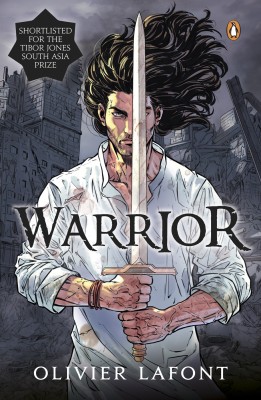
Book review : Warrior by Olivier Lafont

Author: Olivier Lafont
ISBN-13: 9780143423638
Binding: Paperback
Publisher: Penguin Books Ltd
Number of pages: 384
Genre: Fiction
Language: English
Price: Rs.399 (Got a review copy from the author)


About the Book

Join Saam, last son of the destroyer, on his epic quest to save all existence.
In Mumbai, driven to its knees by a merciless blizzard, Saam the watch mender is cornered into an intolerable position. As Shivas only earthly demigod child, it falls upon him to stop his indomitable father.
Bred to war, son of destruction, Saam rides with six extraordinary companions into the horror of a crumbling world to face Shiva. He is forced to join hands with ara, his half-brother he can never fully trust and take with him his own mortal beloved, Maya, on this desperate attempt to stop the end of days. But his path is littered with death, danger and betrayal.
Interweaving mythology, epic adventure and vintage heroism, this enthralling novel will change the way you see gods, heroes and demons.

About the Author


Olivier Lafont is a multitalented and versatile personality who writes fiction, feature film screenplays, and editorial pieces, but also acts in feature films, endorses some of India’s most popular brands on television, and lends his voice to many media in many languages. A French polyglot, Lafont pursues his eclectic interests at the highest standards having worked with some of India’s most acclaimed directors on films like 3 Idiots, Guzaarish and two Hollywood films, and continuing in the same vein with his new novel coming out with Penguin India. He is a familiar face due to his work in over 70 adverts on television.

Gaurav Says

‘Warrior’ takes you right to the ‘reminiscence highway’ of Nolan’s Dark Knight. Bruce Wayne, the reluctant superhero goes into cover as he’s absolutely certain that Gotham didn’t need a vigilante. Picture a Dino Morea version of Christian Bale and you have Saam, the son of Shiva the destroyer, reluctant to don on his god-like powers to save our universe from imminent doom. There lurks one all-pervasive force, ‘The Master’, who have wrecked havoc by threatening to bring in The ‘Judgment Day’, ‘Armageddon’ or *insert your favorite word of carnage here*. This carnage is the immediate effect of the ‘Great Dance’ of Lord Shiva. ‘The Master’ demands all demi-gods, living among us, to either become his slaves and serve to recreate humanity after complete destruction or perish with the impending doom. And unlike the horror movie, ‘The Ring’, the demi-gods have three days in their hands. 
Obviously, the demi-gods, or the ‘Peerless’, turned to Saam to have a talk with daddy (Lord Shiva). However, being one of the many sons of Shiva, Saam has ‘daddy issues’. He ignores the Peerless’ insistence, thereby earning the Peerless’ wrath (more on that later).
The events of ‘End of Days’ starts with sudden gusts of north winds, bringing snow to Mumbai followed by irrepressible earthquakes. To add to it all, Bhopal gets infested by a certain form of fog which disembodies every mortal being that comes in its way (akin to the green mists of Narnia). Saam, although reluctant to seek Shiva’s blessings, started to look for solutions to stop the doom. In comes his half-brother ‘Ara’ who advises him to find the ‘Pure Glass’, which may have some solutions. Before setting up for his voyage, the Peerless tries to eradicate Saam. They first burn his house to ashes and then try to kill him. Hence, a fight sequence ensues where Saam becomes a hybrid of ‘Neo’ from ‘The Matrix’ and ‘King Leonidas’ from 300. ‘SLASH! CUT! REPEAT!’ became his motto for the fight.
The gory fight scene marks the end of first half of the book. In the second two halves, we see Saam teaming up with his brother Era, Era’s companion Moti, Saam’s bikini-body-certified girlfriend ‘Maya’ (because Lafont never fails to describe her tanned skin, perfectly smooth back and sex-appeal almost everywhere), another Peerless ‘Lalbaal’ (yeah! Funny name!), a historian & expert on Hinduism ‘Fazal’ and a turbaned rakshas ‘Fateh’.
‘Team Saam’, hence go on a quest riding their mighty steed (which has an impressive history of serving in the ‘Kurukshetra) to find the ‘Pure Glass’. They confront meek rakshashas, 12 meter tall, who are (surprisingly) prone to the common cold & flu; humanoid pterodactyls, geckos and lizards; the Nagraj who has an underwater library of sorts that holds copies of ancient texts (think of the secret library vault of the Vatican city from Angels & Demons) and ultimately the ‘World Gate’ that allows travelers to traverse between multiple universes (watching Interstellar would help you in this case).
Lafont creates a mash-up of LOTR meets GoT meets Mahabharata. We have valiant demi-gods trying to save the world from complete obliteration. We have hints of ‘Red Wedding’, betrayal and complete chaos among frenzied population. We have mythical characters from Mahabharata come to life. If you subtract the supernatural elements, then Lafont paints a pretty nice picture of human psychology. With the slightest hint of things going wrong, our psychology tends to manifest our inner fears and demonic ideas. Likewise, in the novel, the women take up arms and proclaim their territory while ‘sadhus’ turn on each other and people in general turn into cannibals and feed on corpses.
The only issue I had with the book was the occasionally slow narrative. You’re likely to be bombarded with stretching comparisons like ‘hair as smooth as silk’ or ‘hip-hop such as Honey Singh’  (just kidding). The point is that this incessant need to compare creates major annoyance in the overall narrative. It destroys the speed of the narrative , making it a little tiresome.
Oliver Lafont does really well for a debut novelist. Despite some minor flaws in the narrative, the book manages to grip your attention as it progresses towards the end. The catch phrase for this book is ‘a journey’, one that takes you to different places all over the country and gives you interesting insights about mythologies, legends and folk lores. Its impressive cover page is the perfect prelude to the story that follows. You can definitely judge this book, based on its cover

Reviewed by Gaurav Dutta for Dreams and Drama. Thank you so much, Gaurav 

Tuesday, November 4, 2014

Book Review - Ri : Homeland of Uncertainty by Paulami DuttaGupta

Author: Paulami DuttaGupta
ISBN-13: 978-8192893730
Binding: Paperback
Publisher: Fablery publications
Number of pages: 127
Genre: Fiction
Language: English
Price: Rs.150 (Got a review copy from the author)


About the book

About the Book: Trapped in the limbo between ideology and conscience, Manbha finds himself part of a terror outfit. An unexpected opportunity, anger, squalor and disillusionment - followed by armed combat and injury lead to the soul-searching that form the substance of this moving tale.

About the Author

Born in Shillong, many moons ago, with schooling at Loreto Convent, and an English Honors from St Edmunds College, Paulami started her career with 'All India Radio Shillong'. She wrote and also gave her voice to a few shows there. Later, she came down to Kolkata and got a post graduate degree in Comparative Literature from Jadavpur University. She had also taken a fancy to learning Spanish, but today confesses that she has forgotten most of it. In the past, she has written for 'The Times of India' in the 'Guwahati- Shillong Plus' edition and also 'The Shillong Times'. Television had always attracted her and was connected to the Bangla TV industry for about 6 years. She was associated with ETV- Bangla, Akash Bangla and Sony Aath in this period. Having left her day job in 2012, Paulami took up full time writing. Her first novel 'Pinjar' released in early 2012. She has also contributed to 'Minds@work' anthology and 'Family Matters' international anthology in 2013. Her second novel 'Unplanned Destiny' released in 2014. She is also the screenplay writer of the National Award winning Khasi film - Ri Homeland of Uncertainty. When she is not writing or watching movies, Paulami is either reading biographies or classic pieces of literature. Cricket, food, cinema, books and music are an integral part of her life.

Gaurav says


Ri, a Khasi word for ‘homeland’ takes us to a journey of the heartlands of Meghalaya, Shillong and the India-Bangladesh borders. Along with the varied geographical locations, this book takes you inside the minds of freedom fighters and law keepers. Political scenario, just after thirty years of independence, was much more intense and gory than it is today. Terrorists were gunning down innocents, who sided with the law. The police were nabbing down extremists through fake encounters. Between these two debacles, the northeastern states become unwitting victims. The civilians are torn between ideologies. They are resenting of the ‘local-outsider’ rift. On the other hand, the media glorifies the continuous failures of the administration to contain terrorism. What’s interesting is the drawn parallels between the thought process of the central freedom fighter, Manbha and the SP of Police, Kyndiah. Both want to fight for their beliefs. The former knows in his heart that freedom is the only solution to the excesses of the military. The latter knows that eradicating terrorizing patriots like Manbha, can truly bring peace.

The novel starts in July at Shillong with Kyndiah, weary of a pesky journalist trying to get a scoop out of him. As he steps out from his car to enter the Secretariat’s Office, journalists hound him for information on a fake encounter. The novel quickly moves on to an infiltration of India-Bangladesh border and from then on, to the terrorist camp. Here we read about fellow liberators Steve, George and Kyrmen who plans to exhibit ‘real fireworks’ on the upcoming Independence Day celebration.  
As the plot thickens, we get to learn about the inner conflicts of Kyndiah. He is conflicted between his work and family. He has distanced himself from his relatives while he considers his junior comrades as his own blood. He is troubled by his job. A good night’s sleep is luxury for him. A social life is a blessing. His inner sanctum of peace and calmness is completely shattered. He is under pressure by his seniors to bring atrocities under check. He despises the media and yet he harbors a strong opinion about Janet, a revered journalist. 

Kyndiah’s dilemmas are perfectly brought in sync with that of Manbha. He is in his 20s who left his home in search of a higher truth-freedom! What interested me is that he is equally disillusioned about his fight. Just like Kyndiah, he takes orders of shooting and bombing from his seniors. He is not sure whether his revolutionary ideologies have lost their meaning. At first sight, he is resolute, composed and ruthless. However, on further inspection, he is soft towards his comrades’ inhumanness, meted out to his own Khasi people. He has lofty dreams of bringing independence to Meghalaya. However, he doubts his own aspirations when confronted with reasonable arguments by one of his hostages, Emika. The ultimate showdown between the police and the terrorists is something to look for in the book. 

In true sense, Ri is indeed a homeland of uncertainty. Every gunshot, bombing and encounter reeks of corruption and military barbarousness. It evokes among the Khasis, one of Shakespeare’s famous quote, ‘to be, or not to be’. It means, they want to break away from the Indian union but not sure whether they’ll survive on their own.

The book is a solid page-turner. Paulami DuttaGupta recites the incidents as if they are unfolding right before your eyes. Never would you find a dull moment in the narrative. It will keep you hooked on to the finale, until you reach the last line and realize the bigger picture at play.

Reviewed by Gaurav Dutta for Dreams and Drama :)

Catch my take on the book release event here.

Monday, September 15, 2014

The Poetry Corner: Romantic Exorcism


Romantic Exorcism


Wallowing here at the edge of worlds, 


The nonchalance is disturbed by a burst of light at the cloud splattered horizon. 

The eyes seek a moment of recognition in this Godforsaken land, 

but the vicinity remains devoid of life as it’s just a stray comet, 

which has probably lost his way. 


As the last vestiges of light dissipate from the retinas, 

They resume their quest in the obscurity. 

Your romantic exorcism has peeled the soul off me. 

And I am all alone on my voyage across the seas of Charon. 

Hoping to be reunited with my soul. 


Stuck here at the brink of life and death, 

The lapping of waves against my oars provides an imaginary solace. 

Reminds me of mortal music. 

Time has somehow lost its relevance here or maybe it has ceased to exist. 

All I can do is wonder what my soul is going through, 

Here in this unfathomable oblivion. 


Have you released it from your captivity? 

Or are you still condemning it to your love? 

~Suryea Krishna


Note: Charon here refers to the hypothetical sea on Pluto's moon. However, the poem on the whole is inspired from the Greek myth of the ferryman of Hades who carries the souls of the dead across the rivers which divide the worlds of the living and the dead. 

This was a guest post by our friend Suryea. You can read his other poem on our blog here. We value your feedback so your comments are welcome. Hope you have a wonderful week ahead. May you all blessed be!  :)

PS- The picture has been taken from Google Images.

Tuesday, July 15, 2014

The Poetry Corner: Haunted Heart


Hello, beautiful world! It's Arpita this side and no, I am not posting anything I wrote myself. I know, again. *Le sigh! This is a poem written by our friend Suryea, who was kind enough to let us share it on our blog. He has also contributed a book review to Dreams and Drama and you can take a look at it here. We hope you'll like this creative piece and that you will share your feedback by leaving a comment!

Haunted Heart


Let me guide you through my haunted heart. 
Welcome to the universe of broken dreams & shattered emotions, 
Which cause innumerable quakes in this lava-land. 
Quakes which brought deep ravines & cuts in the heart, breaking it into many pieces. 

Heartbreak has slaughtered Love in this haunted heart.
Let me show you around my haunted heart. 
Welcome to the world of eternal sadness & loneliness, Which cause many a volcanic eruptions in this ash-land....Volcanoes which spew sorrow in all directions across this heart. 

Sorrow has savaged Happiness in this haunted heart.
This luckless land, love & happiness have alienated, 
And have left behind a dark void which is free from all feelings, 
And only an everlasting oblivion prevails over this heart. 

Ghastly ghosts have started rushing in to fill this emptiness, 
They now frolic in this haunted heart.
These ghostly apparitions speak of strange memories & thoughts in their whispers. 
Whispers which rekindle the eerie silence pervading over this heart... 

The shadows of these ghosts are the first pleasant manifestation on this haunted heart.

The ghosts have unlocked iron chains & have unleashed ferocious beasts, 
From hidden caverns inside the depths of this heart. 
With these ghosts & beasts running unchecked across the heart, 
An unreal security & safety has developed in this haunted heart

The ghosts & beasts are spawning more of their kind. 
In the absence of Love & Happiness they are overrunning the whole heart. 
This heart has recast itself into a new unbreakable shell of black darkness, 
And has opened up to weird vistas of haunting. Hope you enjoy your stay in my haunted heart.

~ Suryea

Wednesday, June 4, 2014

Book Review: The Greatest Works of Kahlil Gibran


FIRST JAICO IMPRESSION: 1991

THIRTY-FIRST JAICO IMPRESSION: 2013


ISBN: 81-7224-134-8

GENRE: Philosophy/Parable/Poetry/Novel

PRICE: Rs. 299/- 

(review copy  from the publishers.)

ABOUT THE AUTHOR: 

Khalil Gibran (January 6, 1883 – April 10, 1931) was a Lebanese artist, poet, and writer. Born in the town of Bsharri in the north of modern Lebanon, as a young man he immigrated with his family to the United States, where he studied art and began his literary career, writing in both English and Arabic. 

In the Arab world, Gibran is regarded as a literary and political rebel. His romantic style was at the heart of a renaissance in modern Arabic literature, especially prose poetry, breaking away from the classical school. In Lebanon, he is still celebrated as a literary hero.

He is chiefly known in the English-speaking world for his 1923 book The Prophet, an early example of inspirational fiction. The book sold well despite a cool critical reception, gaining popularity in the 1930s and again especially in the 1960s counterculture. Gibran is the third best-selling poet of all time, after Shakespeare and Laozi.

What you might have not known about the author: Due to a mistake at a school in the United States, he was registered as Kahlil Gibran, the spelling he used thenceforth.

SYNOPSIS: 

The Greatest works of  Kahlil Gibran by Jaico Books is an omnibus collection of 12 books including The Prophet, The Wanderer, Sand and Foam, The Madman, The Forerunner, The Earth Gods, Nymphs of the Valley, Tears and Laughter, Between Night & Morn, Secrets of the Heart, Spirits Rebellious, and The Broken Wings.

The Prophet is a book of 26 prose poetry philosophical essays. The prophet, Almustafa, has lived in the foreign city of Orphalese for 12 years and is about to board a ship which will carry him home. He is stopped by a group of people, with whom he discusses topics such as life and the human condition. 

The book is divided into chapters dealing with love, marriage, children, giving, eating and drinking, work, joy and sorrow, houses, clothes, buying and selling, crime and punishment, laws, freedom, reason and passion, pain, self-knowledge, teaching, friendship, talking, time, good and evil, prayer, pleasure, beauty, religion, and death.

The Wanderer, The Forerunner, Tears and Laughter, The Madman, Between Night and Morn, The Secrets of the hearts, are collections of assorted poetry prose parables with philosophic or at times even spiritual undertones.

Sand and Foam is a collection of Poems and Sayings.

The Earth Gods is a beautiful composition from the point of view of three Earth Gods who study what goes on Earth and keep discussing their observations and issues. One of them wants to get rid of his immortality.

Nymphs of the valley, Spirits Rebellious, and The Broken Wings are a collection of fictional short story parables.

EXCERPTS:

"We wanderers, ever seeking the lonelier way, begin no day where we have ended another day; and no sunrise finds us where sunset left us. Even while the earth sleeps we travel. We are the seeds of the tenacious plant, and it is in our ripeness and our fullness of heart that we are given to the wind and are scattered." ~ The Prophet

"Half of what I say is meaningless, but I say it so that the other half may reach you." ~ Sand and Foam

"The bad omen of one is the good omen of another." ~ The Lion's Daughter, The Forerunner

"Substantial things deaden a without suffering; love awakens him with enlivening pains." ~ A Poet's Voice: Part 1, Tears and Laughter

"Alas! Sleeplessness has weakened me! But I am a lover, and the truth of love is strong. I may be weary, but I shall never die." ~ Song of a Wave, Tears and Laughter

"I am sweeter than a violet's sigh; I am more violent than a raging tempest." ~ Song of Love, Tears and Laughter

"Yea, in your own soul your Redeemer lies asleep, And in sleep sees what your waking eye does not see." ~ The Earth Gods

"This tide of ever remembering and forgetting; This ever sowing destinies and reaping but hopes; This changeless lifting of self from dust to mist, Only to long for dust, and to fall down with longing unto dust, And still with greater longing to seek the mist again." The Earth Gods

Favorite lines: "My daughter, we ourselves are the infinately small and the infinately great; and we are the path between the two." ~ The Path, The Wanderer

Interesting Fact: The opening lines of "The Prophet" plays heavily on the "immortal" quatrains (Century IV, Q30-Q31) of the largely discredited works of French "seer" Nostradamus. Interestingly, Gibran's full name is Gibran Khalil Gibran and to which the "number of the beast" 666 of the Book of Revelation (which is itself regarded by Biblical scholars as a dubious work) could easily have been ascribed by Gibran as referring to himself. These unfortunate coincidences most likely inspired Gibran's opening lines of "The Prophet".

SURYEA SPEAKS: 

The first thing that one notices when one first begins reading this book is a sense of familiarity. This sense of deja vu might be due to certain commonalities between Gibran's philosophy and our own spiritual experiences. Since he believed in the unity of all religion and even had strong connections with the Bahai'i faith, people of most religions would enjoy his writings. 

"The  Prophet" for example is an impressive compendium of different aspects of life. Often quite practical, often the metaphysical; there is no doubt that Gibran's words manage to transport you to a different magical realm and ultimately makes up to be an interesting read. Unlike Aesop the Gibran parable is hardly moralistic. It leans more on bleak irony and naturalism. Though they both rely heavily on personification. 

I'll cite a few examples here:-

Themes like: "A rich man locked inside his iron safe, perishing from hunger amid heaps of gold."
Imagery like: "Look at the Darkness, giving birth to the Sun."

The comparison between the materialistic and the sincere (which is considered Godlike) is central to Gibran's writings.

The thing I liked the most about the poems and sayings collected under "Sand and Foam", was the artwork between the lines. Not to mention, the author's very own illustrations that have been used in this edition. The cover page artwork is also up to the mark.

The only issue that I had with this copy is that the page numbers were not in proper sync with a master "contents" table. The books were mentioned in an index but they had their own separate "page numbers" independent of a common "table of contents".


All in all, this is surely a collector's item. It is also the kind of volume that everyone should have at their homes. Happy reading!

(Reviewed by Suryea for Dreams and Drama)